Digitisation and archiving of documents as the future of digital asset management
The virtual document archive is a step, in fact a big leap, towards streamlining the flow of information. As is well known, the multi-step automation of activities can significantly transform the conventional tasks that have hitherto burdened employees. Electronic document workflows have a positive impact on the functioning of all sectors of the company almost immediately after implementation, with staff focusing on more important tasks than tedious paper checks.
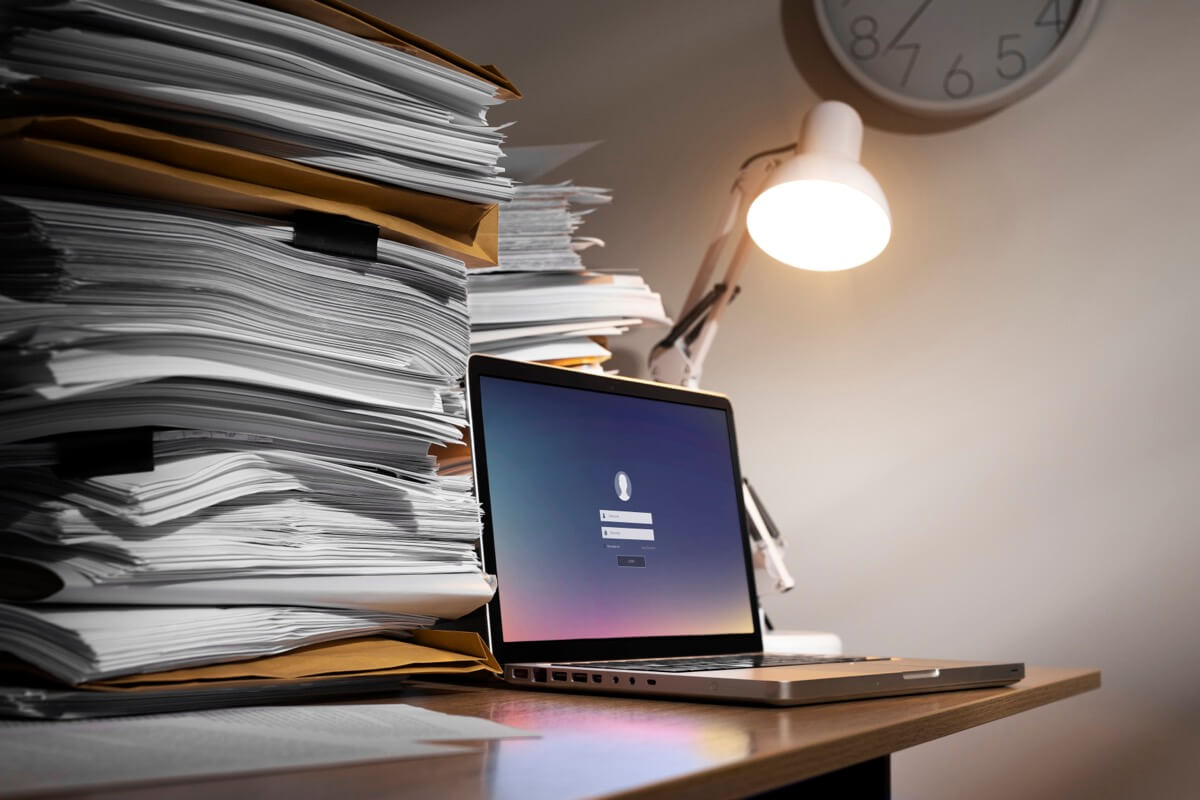
The ever-increasing volume of business data is a phenomenon faced by many companies operating in modern realities but tied to old-fashioned methods. We leave aside „card” technology and the once ubiquitous memory stickers, although instances of sensitive data being saved anywhere are not uncommon. In a professionally managed company environment, folders and binders can fill office space and archive shelves very quickly. Easy access to strategic information, agreements, contracts or business documents becomes almost impossible at some stage. And when a person who has a little secret knowledge of the documentation-filled archive is absent from the workplace, unnecessary conflict situations can arise.
We also recommend: Information technology and safety in working with it
Electronic document archives and company data security
Computerisation and digitisation even extends to places such as the Institute of National Remembrance, which can be a tongue-in-cheek approach for those distrustful of the security and quality of digital data. Investment in electronic document archive will not only streamline and unify the company's business processes, but will also contribute to the company's competitiveness in the long term.
An electronic archive makes it possible to store accounting documents, personal data or contracts with business partners, which can be catalogued and searched for much more easily than browsing through piles of binders with papers. Thanks to its flexibility, the company's e-archive is a solution that provides benefits and increases the work efficiency of companies from various sectors, regardless of the size of their operations and the amount of data stored.
In a world of fast-paced technology, the electronic archive is becoming part of modern records management. It relieves employees of many responsibilities, as there is no longer a need, for example, to keep track of the most important dates - the expiry of a contract or the renewal date of a commercial contract. A comprehensive electronic archive system will tell you when you need to perform an action on a document that requires it, and it keeps a full history of changes to each element, process or field. Above all, it gives immediate access to information and simplifies the processing of current and archive documents within a single programme.

Introduction of electronic documents - facilitating document management
Reducing the circulation of the „original” paper document to the bare minimum minimises the risk of it being damaged or destroyed, which is extremely important in the case of important contracts signed by hand. An electronic archive has a beneficial effect on better organisation of work and is particularly useful where there are several independent teams of people working in several departments or under different working models. An e-archive allows documents to be made available to a wider audience than locally stored folders or files, in an instant and fully controlled manner.
Thanks to the automation of processes, quick and convenient access to new documents and archived data in electronic form makes it possible for a larger number of employees to work simultaneously. It also improves communication between system users, thanks to the option of recording additional information directly in the electronic version of the document, something like a note „in pencil in the margin”.
E-archive functions that replace paper documents
The launch of an electronic document archive will also enable organisational changes on another level, for example, the use of space that has so far only been used to store paper documents. Disappearing bookcases and filing cabinets will allow office space to be expanded, and for small companies are an opportunity to reduce costs. The opportunity to move your business to a smaller facility or a more favourable location can be the impetus for change. Being based in a modern office building in an attractive location for many businesses will go hand in hand with innovative records management.
Electronic systems offer advanced options for digital documents, such as encryption and backups, providing better data storage protection. Overall, an e-archive of documents is more efficient, secure and cost-effective than traditional paper-based document archiving methods. The company is freed from the need to organise and keep an eye on information in a traditional archive, while the full digitisation of documents allows the company to organise data according to its own almost unlimited criteria and increase the efficiency of document management.
As far as the electronic document archive is concerned, its operation can be adapted to the user's needs. The system allows reports to be generated and archive resources to be quickly browsed and searched. It makes it possible to create virtual copies of documents and save them in one place, easy to manage and with access from anywhere in the world with an Internet connection.
Is it safe to store files in a company document e-archive?
Current legislation requires paper records to be kept for several years. They should be well described and organised so that searching for them is easy, which is extremely labour- and time-consuming. Commercial documents or invoices need to be accessed more often, others are looked at occasionally, and most rest on shelves untouched for months or years. Either way, the traditional paper archive is quite cumbersome to manage, guard and inventory.
The high level of security provided by the various functions of the electronic archive calms fears of leakage or loss of important data. Electronic archiving makes it possible to search for a given document at an express pace and reduces the time it takes to prepare tasks. In the near future, advances can be expected in cloud integration, process automation and the use of artificial intelligence to analyse data, allowing the company and its resources to be managed from the screen of a single internet-enabled device.
By protecting the important information contained in electronic documents more effectively, part of the paper archive collection can be moved to a single secure, locked and supervised location. Only the most necessary documents can be kept on hand, although it is only a matter of time before the law is amended to completely eliminate the need to store papers in the office.
 Polish
  English