
DMS, or document management system
A DMS (Document Management System) is specialised software that is used to electronically manage documents within an organisation. Thanks to it, it is possible not only to store documents digitally, but also to organise them, control the versions, establish access rights and, above all, streamline the document circulation process in the company.
A DMS enables the creation of a digital archive where documentation is always organised, accessible and secure. The document management system gives you full control over the documents in your organisation, regardless of their format.
How does the DMS system work?
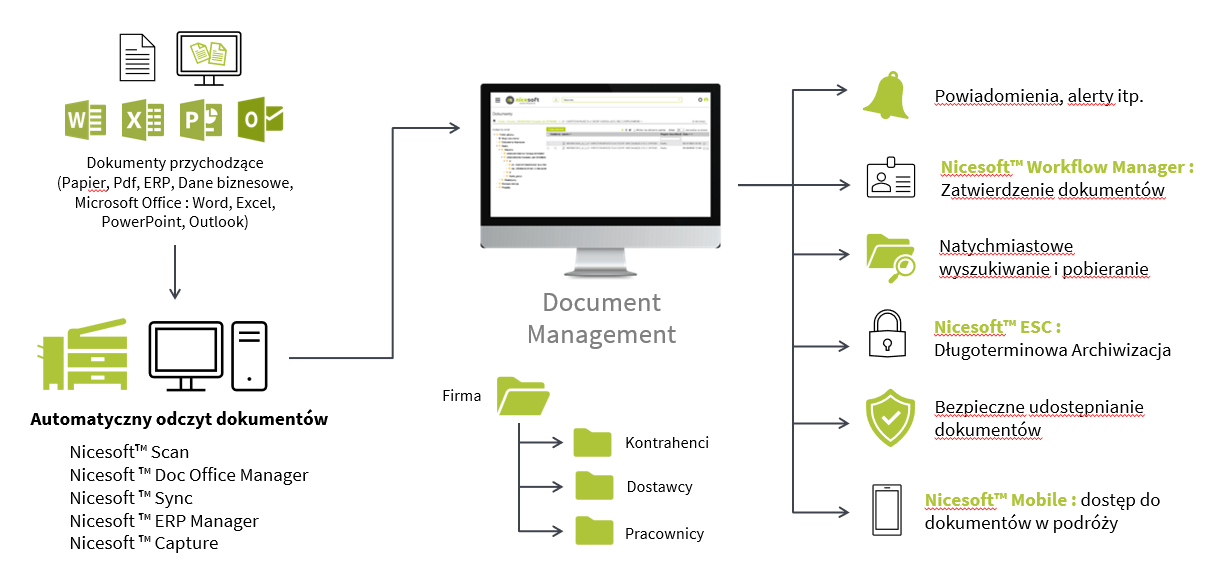
The DMS acts as a central platform, integrating with other IT systems such as ERP or CRM. It allows the automation of processes such as the acceptance of invoices, the registration of contracts or the generation of reports. In practice, this means that a document enters the system, e.g. by scanning or e-mail, is then automatically classified, assigned to the relevant process and made available to selected employees.
Features of the DMS include OCR (Optical Text Recognition), automatic workflow, versioning, the ability to integrate with electronic signatures, and regulatory-compliant archiving.
You may be interested in: Working in CRM - how do I get started?
DMS in various industries

A document management system works well in any industry. In manufacturing companies, it enables control over technical documentation and compliance with standards. In the financial sector, it automates invoice workflow and ensures compliance with RODO. In the service industry, it streamlines work with clients and speeds up the company's workflow. In law firms, it is possible to legal records management, which makes it much easier to navigate through the maze of regulations, files and cases, providing quick access to key information.
The DMS is becoming particularly useful where documentation is growing rapidly and where rapid response and full compliance with procedures is important.
Benefits of the document management system - NiceDMS

A well-designed document management system can revolutionise the day-to-day work in a company - from organising documentation to automating the most time-consuming processes. There are many such systems that help companies manage. We, would like to focus on our system - the NiceDMS.
One of our clients, from the catering industry, regained full control of its documentation in just two weeks thanks to the implementation of our NiceDMS system. This shows that even complex processes can be streamlined quickly and effectively.
Previously, employees wasted hours every day searching for information, printing documents and obtaining signatures from superiors. After implementing NiceDMS, every document was instantly accessible from anywhere, automatically sent to the right people and securely archived.
NiceDMS enables, among other things, automation of document workflow, integration with ERP systems, OCR and an authorisation management module. The system significantly streamlines business processes, improving the quality of work and eliminating paper circulation.
See also: Archiving of accounting records - proper filing of documents
Key benefits of the DMS:
- Getting your documentation in order quickly
- Automation of time-consuming processes
- Full control over documentation
- Instant access to documents from anywhere
- Automatic transmission of documents to relevant persons
- Secure document archiving
- Automation of document workflows
- Integration with ERP systems
- Integration with OCR systems
- Entitlement management module
- Significant improvement in business processes
- Improving the quality of work
- Elimination of paper-based workflows
How much does it cost?
The cost of implementing a DMS depends on a number of factors: the number of users, the degree of integration with other systems (e.g. ERP), the range of functions (OCR, workflow, electronic signature), and the implementation model (cloud-based vs. local).
Prices start at just a few hundred zloty per month in the SaaS model, making the DMS also accessible to smaller companies. For larger organisations, the price may increase, but the benefits are also proportionately greater. NiceDMS offers flexible packages tailored to the needs of each client.
If you would like to find out more about our system - make an appointment for a free consultation.
Data security and DMS

Is a DMS safe? The answer is yes, as long as you choose proven solutions. Document management systems offer advanced security mechanisms such as data encryption, access control, user activity logging and backups. When it comes to our system, we realise that cyber security is very important, especially in today's world. Therefore, we make sure that NiceDMS is secure and functional.
We recommend considering a comprehensive approach to business data protection. In addition to a DMS, our company offers solutions UTM (integrated network security management), backup systems and monitoring of the IT infrastructure. This ensures that an organisation's entire IT ecosystem is protected against data loss, external attacks or human error.
Summary - Electronic document circulation
Today, the implementation of a DMS system is not a luxury, but a necessity for any company that wants to function efficiently in the digital world. A well-chosen solution allows not only to put documents in order, but also to accelerate the realisation of processes, increase data security and ensure compliance with current regulations. NiceDMS is an example of a modern and flexible system that supports teams in their daily work, increases operational efficiency and eliminates the problems associated with paper document circulation.
FAQ - questions and answers
Can the DMS be integrated with other systems?
Yes, most modern DMS systems allow integration with ERP, CRM, email or electronic signature systems.
Is the DMS compliant with RODO?
A well-designed DMS supports compliance with the RODO, enabling access control, data encryption and quick retrieval of personal information, among other things.
Is a DMS only for large companies?
No. There are DMS solutions on the market tailored to the needs of small and medium-sized enterprises - both in terms of cost and functionality.
How long does it take to implement a DMS?
The implementation time depends on the size of the organisation and the level of customisation of the system, but usually takes from a few days to a few weeks.
 Polish
  English