Recommended time and attendance software
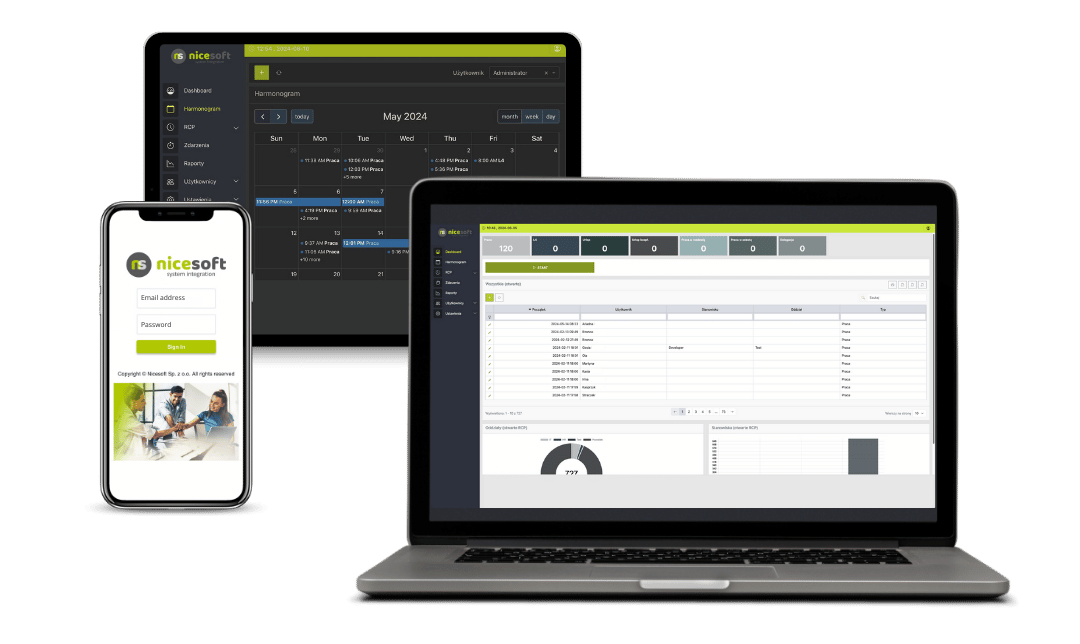
- NiceWorkTime: A state-of-the-art electronic timekeeping system that enables precise monitoring of employees' entry and exit times. Replaces traditional attendance lists, automating the recording process and minimising the risk of errors. Available on a variety of devices, allowing you to keep track of working time both in the office and remotely. It is a Polish software that enables the generation of detailed reports on employee attendance and activity, allowing for better analysis of team effectiveness.
- TimeCamp: Polish timekeeping software that offers automatic tracking of employee activity, generation of detailed reports and integration with popular project management tools. Enables productivity monitoring and effective team management.
- Clockify: Free time-measuring software that allows you to track working hours in real time, create reports and monitor progress on projects. Available on a variety of platforms, including mobile devices, making it easy to manage team time.
- Toggl Track: Intuitive time and attendance tool offering features such as real-time time tracking, reporting and integration with other applications. Enables analysis of work efficiency and optimisation of company processes.
What is time recording and what should it look like?
To begin with, an explanation - what exactly is the difference between time registration and record-keeping? Time recording involves monitoring the actual time an employee enters and leaves the workplace. The entrepreneur receives an accurate list of each team member's attendance, and this makes it possible to control punctuality, overtime or breaks. This solution uses a variety of entry and exit recording technologies - magnetic cards, biometric readers or mobile applications.
Employee time recording is a slightly broader concept that includes not only the recording data, but also its processing to provide the full documentation required by law. The records take into account, among other things:
- days off, holidays, sick leave,
- overtime,
- on-call periods,
- and other details in accordance with the Labour Code.
While registration focuses on the day-to-day collection of data, records provide a tool for analysing and archiving this information. It is also used to determine the remuneration of employees and to control compliance with employee rights related to working time.
Read also: Working in CRM - how do I get started?
RCP system - how does the programme work and how to choose it?

The Labour Code requires reliable time records to be kept for each employee. The software provides access to complete and legally compliant reports that can be presented during a possible audit. Automatic recording of working hours excludes human subjectivity or potential conflicts, such as overtime or lateness. Employees also have access to data about themselves, and this increases the sense of fairness and transparency in these accounts.
Which is the best programme? One that allows integration with other business programmes responsible for controlling specific areas of the company. One that is easy to use, scalable, intuitive and ensures compliance with current laws and regulations. Electronic working time records essentially eliminates the need to enter any data manually, and the employer and HR department can focus on more strategic tasks.
The modern time and attendance system integrates easily with HR and payroll tools. This makes payroll calculation, leave management or roster planning much easier, especially for companies with a large workforce. The system always operates in real time, minimising the risk of calculation errors and helping to accurately monitor hours worked, overtime, breaks or absences.
How does the electronic time recorder perform in different industries?

In the retail sector, in large shops and warehouses, where the number of employees varies seasonally, RCP systems allow for ongoing record-keeping and time management of temporary and permanent employees. It is also a great tool for analysing performance during peak sales hours. In the HoReCa industry, in restaurants, guesthouses and hotels, the work schedule changes dynamically - here, time and attendance programmes help to plan shifts and control the work of individual teams, including cleaning staff or cooks working in different modes.
Read also: Effective Business Backup Methods. Acronis Practical Guide
Integration of RCP and CRM using the example of a manufacturing company - key benefits

Employees, when they are aware that the system for calculating working hours is fair and objective, feel more motivated to perform their tasks reliably. On the other hand, RCP software generates reports on employee performance, and based on these reports, management can make better decisions on optimising production processes or reorganising teams. This is a situation of sorts Mutually beneficial, when both parties gain trust in each other, and this, as we all know, translates into a good atmosphere, increased productivity and maximum efficiency.
Electronic time recording - stages of implementation and summary of benefits
- Difficulties in managing shifts and work schedules.
- High costs associated with overtime accrual errors.
- Lack of clear working time records required during legal inspections.
- Problems with motivating the team due to the lack of transparency of accounts.
NiceWorkTime provides comprehensive solutions for businesses of all sizes. There are several methods of recording working time, and the choice depends on the company's expectations. However, a customised solution allows you to benefit from such functionalities, among others:
- recording of employee entries and exits with RFID card readers and others
- integration with the HR and payroll system,
- automatic shift planning, change management and staff turnover,
- generation of reports in accordance with labour legislation.
The implementation process usually takes between three and four weeks, depending on the scale of the company. However, the effects are visible almost from the first moments of its operation. The sum of the benefits is as follows:
- Saving time - by automating processes, the HR department reduces the time needed for manual time accounting.
- Reducing overtime costs - The system immediately informs managers when standard working hours are exceeded.
- Improving production efficiency - precise data allows better allocation of human resources, thereby reducing lead times.
- Employee satisfaction - all stakeholders can access their data via the mobile app, the sense of trust and motivation within the team increases.
Finally, it is worth adding that electronic system for monitoring working time can be integrated with other business programmes responsible for controlling individual areas of the company's operations. Collaboration of the RCP system with external IT tools offers further benefits - increased management efficiency, reduced human error, automation of repetitive processes and more effective reporting.
 Polish
  English