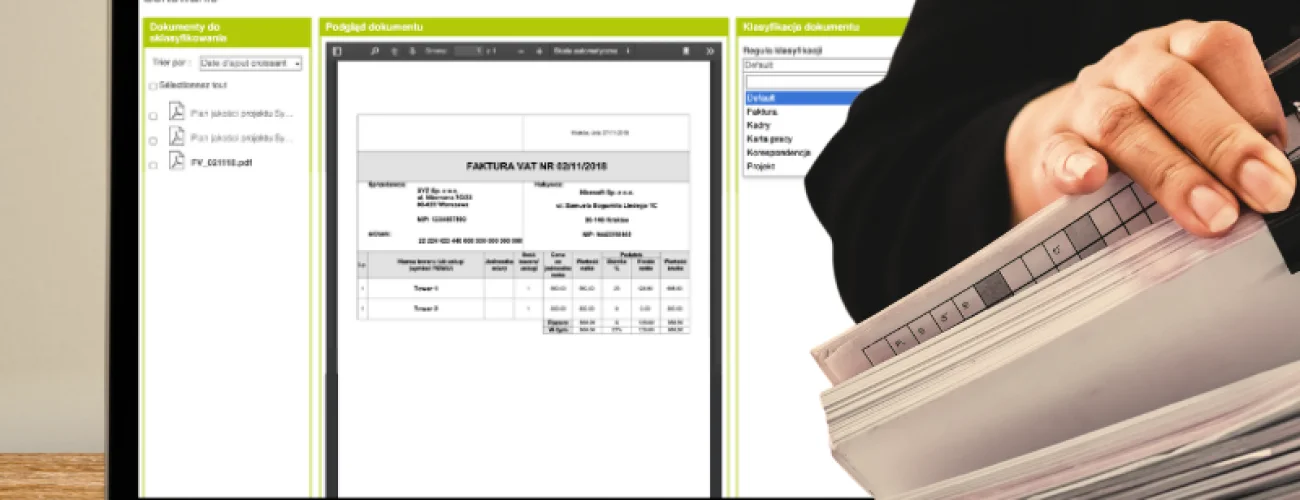
What does the company's accounting records cover?
In every company, there is a need for accounting records. This is a very broad category that includes, among other things, those documents that serve to confirm operations carried out, such as the sale of goods, and to certify the company's current financial situation.
The proper accounting of transactions carried out in a company often requires the issue of accounting documents to an external party, such as a client. This includes, in particular sales invoice, including with or without VAT, or a receipt or accounting note. There may also be a need to issue adjustment documents, for example when the purchaser has returned part of the order.
The accounting evidence may also relate to different types of records, for example fixed assets or mileage of vehicles used for business purposes. Such evidence is also needed for:
- tax settlements in the form of a KPiR (revenue and expense ledger) or an accounting ledger;
- inventory documents;
- documents submitted to ZUS, including personal monthly reports and corrective and settlement documents.
Accounting documents comprise collections of accounting records that are complex in nature. It is difficult to keep track of them, especially if you have many employees. Therefore, when managing a company, it is important to know the basic principles of proper document filing.
Read also: Archiving system for bank documents - which programme to choose?
Why is it important to know how to properly store documents in a company and what are the time limits for keeping records?

Knowing the rules and time limits for keeping accounting records will enable you to to organise and streamline its circulation in your company. By regularly liquidating documents, you will ensure that unnecessary printouts no longer take up extra space. In addition, you will ensure easy access to all accounting evidence, which will streamline your business processes.
Nor should we forget security issues. The stock of documents produced in an organisation is subject to special protection due to the fact that it contains a lot of information and data that should not fall into the wrong hands.
Regulations, laws and provisions concerning the archiving of personnel and tax documents
To ensure the correct time and place for the storage of company documents, follow the regulations contained in:
- regulation Minister of Family, Labour and Social Policy of 10 December 2018. on employee documentation;
- the Accounting Act (dated 29 September 1004);
- Labour Code (of 26 June 1974);
- tax ordinance (of 29 August 1997).
Also relevant are the regulations contained in the RODO, i.e. the Regulation on the Protection of Personal Data, as well as the Act of 14 July 1983 on National Archive Resources and Archives. It mentions, among other things, how to deal with employee records in the event of liquidation of a company.
Read also: Electronic employee personnel files vs. traditional ones
What does the correct archiving of accounting documents look like?
What is the retention period for accounting documents?
Documents relating to settlements with contractors and records must be retained for a period of 5 years, from the end of the calendar year in which the tax deadline expired. Invoices issued in 2020, for example, must therefore be archived until the end of 2026. - then the limitation period for the tax liability will expire.
The 5-year period applies not only to accounting evidence and inventory documents, but also to settlements with Social Security. It replaced the previous 10-year retention period that applied to documents submitted to ZUS until 29 December 2011.
By contrast, the standard retention period for employee documents, such as personal payroll or time sheets, is 50 years from the date of termination of employment at that location. However, for those with employment in 2019 and beyond, there has been a reduction in the period of record retention from 50 to 10 years.
Where should inventory or personnel documents be stored?
In the case of original documents, you can store them both in the in both paper and electronic form. If you choose the former, you need to ensure that there is a separate area that can be easily accessed by those responsible for the management of the company and for human resources matters. Such a place should be free of humidity and properly secured, for example with an electronic lock. However, it can be a big problem that not every company has enough space to have a separate area.
Basic principles of archiving tax, HR or inventory forms and other company documents
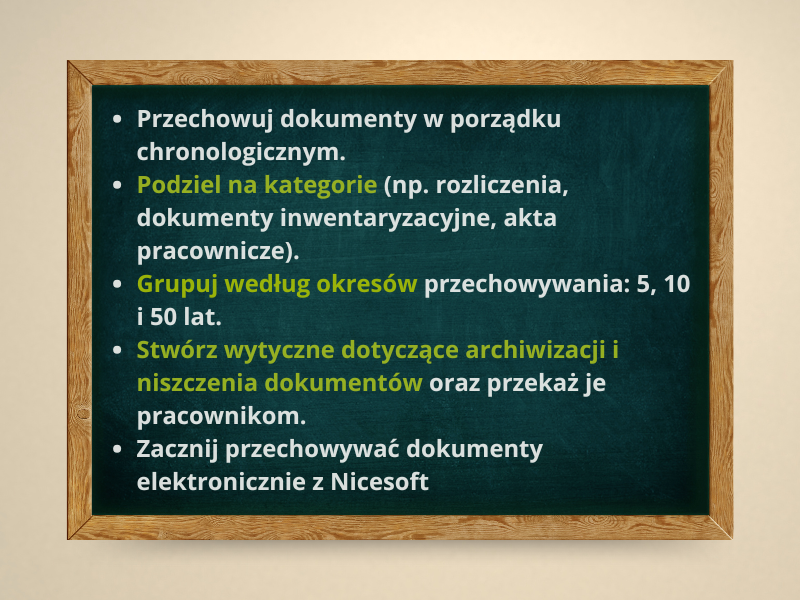
Annual collections of accounting evidence and documents worth keep in chronological order and group together. You can divide them by:
- type of accounts - sales and purchase receipts, employee files, inventory documents, etc;
- retention period, i.e. 5, 10 and 50 years.
Worth harmonise the principles adopted by the entity, so that they are identical throughout the organisation, at all levels of management. You can write down guidelines on how to archive records and how they should be destroyed, and pass them on to all employees.
Is archiving company documents electronically a good idea?
- Supervision of documentation in the system - The system allows personnel documents to be tracked and their physical location to be determined.
- Digitisation with location information - The addition of digital location details improves document identification and helps to manage office space more efficiently.
- Saving time for employees - digital document organisation reduces the time spent searching for documents, allowing you to concentrate on more valuable tasks.
- Simple and intuitive operation - facilitates the conversion of documents into digital versions and their organisation.
We also recommend the system contract management, which will be an ideal complement to archiving. Such a programme allows quick access to key documents, even remotely. It also allows easy categorisation of contracts, which speeds up their organisation. It offers full control over documentation, including processes related to its destruction. Regulatory compliance makes it easy to set time limits for document retention, without having to sift through legislation. Provides a high level of security, protecting documents from damage such as fire.
It is worth choosing a document storage service provided by an external provider, as this will you do not need to set aside space within your company for the storage of accounts. The digital archive has many additional features that will make day-to-day operations easier. For example, you can monitor days since the issue of accounting documents, use electronic signatures, both qualified and unqualified, and create back-up accounting records in electronic form.
The digital system also has a positive impact on the environment, as it you don't have to generate a pile of paper documents every month. Storing accounting records electronically is therefore worthwhile not only for usability or security reasons, but also for environmental reasons.
Do you want to streamline your company's business processes? You can collect, archive and destroy all related documents within a single system. No time is lost in handling and maintaining documents until the legal period expires. The digital module is the ideal way to store and secure company documents.
 Polish
  English