
What is the archiving of bank documents?

- documents generated in connection with the acquisition of specific products (accounts, cards, loans, etc.) by customers - these include contracts, statements and printouts, transfer orders or cheques;
- tax, personnel or inventory documents.
As part of archiving, accounting evidence and other types of documents that are generated in the course of banking activities should be kept in an efficient and safe manner.
Why should client contracts or accounting and tax books be stored properly?

Fast document circulation
Proper retention and archiving practices for documents produced in connection with the bank's operations will allow for efficient data exchange between its various departments or divisions. This is crucial to ensure its smooth operation and prompt service to customers.
Easy access to documentation
Through archiving, it is possible to bring copies of documents together in one place. This will allow convenient access whenever needed, for example in the face of an inspection by an authority.
Well-organised archiving improves records management and reduces the time needed to search for specific data, which increases the efficiency of the team and avoids delays and errors due to lack of access to key information. In addition, modern archiving systems, often integrated with digital databases, allow documents to be managed electronically - further enhancing security and enabling documentation to be accessed remotely, in a secure manner.
Compliance with legislation
Accounts, tax documents or employee files must be kept in such a way that have not been damaged for a certain period of time. If you ensure that they are properly archived, you do not have to worry about breaching any of the laws.
Data security
Secure storage of bank documents will reduce the risk of data theft, which could have disastrous consequences for the bank and its customers. Failure to follow these rules can lead to the leakage of personal data, passwords or transaction information, with serious consequences - both financial and reputational. For customers, the consequences, such as financial fraud or identity theft, can be dramatic, and for the bank, involve loss of customer trust, financial penalties and huge reputational rebuilding costs. Therefore, the secure storage and management of documents and the ongoing training of employees in data protection are the cornerstones for the safe operation of banking institutions.
Read also: Archiving of accounting records - proper filing of documents
What are the rules on archiving bank records? What is the correct retention period for documents?
In any bank, the management of data records and information must be done strictly in accordance with the law. Issues related to this are regulated in various acts, such as:
- Banking law - The law was issued on 29 August 1997;
- Accounting Act of 29 September 1994;
- Regulation of the Minister of Finance of 1 October 2010 on specific accounting principles for banks.
Bank records should be managed in such a way that this is also compatible with provisions on the protection of personal data, including with the RODO (this is due to the fact that the bank is the controller of personal data), as well as with the norms concerning the retention period of employee forms (Labour Code of 26 June 1974) and with tax regulations (Tax Ordinance of 29 August 1997).
How long to keep bank documents? Documents relating to the business of the bank must be hold for a specified period. The retention period for accounting, tax and transactional records is at least 5 years after the end of the financial year. For employee records, this is a minimum of 50 years, but for employment relationships established from 2019 onwards, documents must be retained for 10 years.
The correct document filing rules include designation of archive categories. You can group them both chronologically and in terms of the type of documents or their subject matter.
How to store accounting and inventory documents produced at the bank - electronically or on paper?
The bank's document storage system can be implemented on paper. However, it is inefficient and not very convenient, It creates piles of paperwork that need to be stored somewhere and there is not always room for it. In addition, it creates significant data security risks. Also, an external medium, such as a storage device, will not quite work as it is exposed to damage, for example after a fall from a great height.
A much better solution for document archiving is to digital contract management system. It is the ideal solution for any bank, as it centralises all activities, including the collection, processing or destruction of documents.
What are the advantages of a digital archive of bank documents?
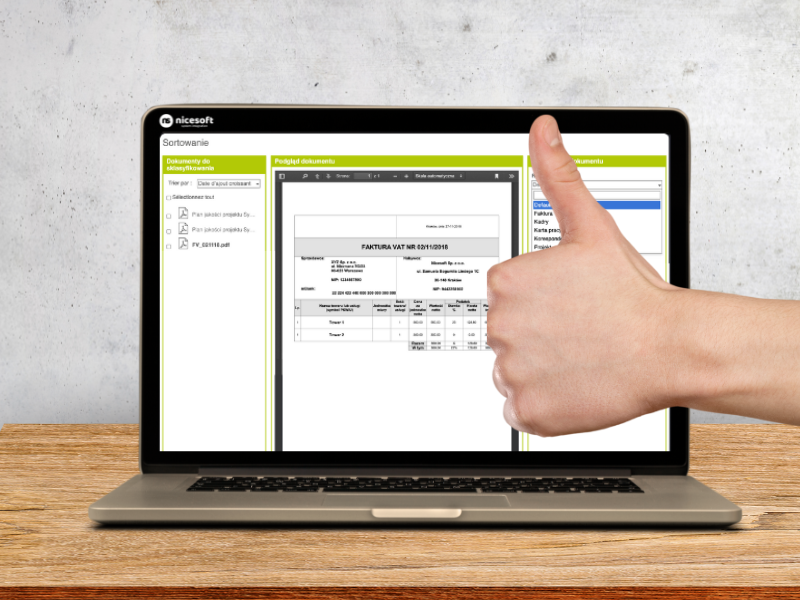
- automation of the document flow - they do not have to be manually transferred between departments, which streamlines processes within the bank;
- permanent control of the collection and processing of data, which is important, for example, in the context of meeting the requirements of RODO;
- convenient categorisation of contracts, You can group them not only chronologically, but also by product or service type or customer category (retail, corporate, etc.).
With electronic document handling, effectively you eliminate the risk of them being damaged by fire, for example. In addition, you will prevent many mistakes that could be made by employees when archiving contracts and lead to extremely negative consequences, including financial penalties, for example, for failing to comply with statutory requirements relating to the archiving period of records.
Every bank has a duty to keep accounts or employee records and to comply with RODO regulations. It is worth making it easier for yourself and switching from paper to electronic documents as part of your archiving.
You may be interested in: Time management in the logistics department - do it effectively
Which electronic system for storing bank records should I choose?
When it comes to storing documents produced by the bank, the best solution is to entrust an external company with the related activities. There are many systems available on the market, so you are bound to ask yourself which one to choose?
In the case of banks, the documents related to their operation are easily sorted and stored thanks to an IT system that has comprehensive and covers the entire life cycle of contracts. With such a system, you can not only archive documents, but also generate and confirm them with electronic signatures and, once the deadlines set by the Accounting Act and other legislation have passed, destroy them.
Efficient document management is ensured by a system that is, moreover:
- centralised and operates in a single integrated environment;
- flexible and scalable, and therefore one that can be easily adapted to a specific bank, including in terms of staffing levels;
- safe, It is equipped with state-of-the-art solutions to ensure that documents are adequately protected;
- functional - In the course of the bank's day-to-day business, for example, the function of intelligent monitoring of deadlines and payables and receivables will come in very handy.
All of these requirements are met by the programme offered by Nicesoft - NiceDMS for records management. It is also worth betting on this provider because it provides a range of other IT solutions that will come in handy during banking activities. This includes, for example intranet, The Intranet is an extremely friendly environment for data exchange and collaboration. The Intranet will contribute to better organisation of daily work in the bank, to fast communication between departments and employees and to easier delegation of tasks, as well as to increased security by reducing external connections.
 Polish
  English