
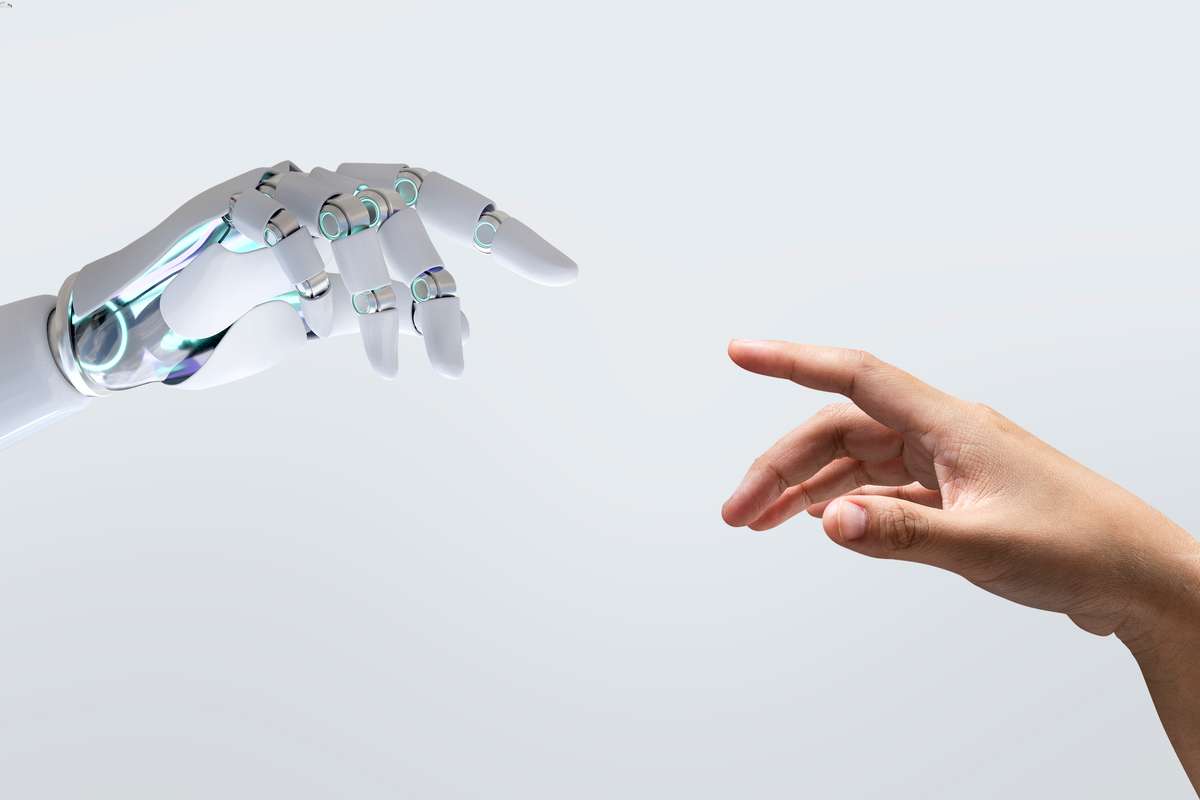
More than half a century later, we can talk about HAL 9000 with chatGPT, his grandson and a symbol of entering a new phase of the computing revolution - the widespread and conscious use of artificial intelligence capabilities across a wide spectrum of activities. The ability to communicate with people, analyse situations, make decisions and control various systems - HAL 9000 could do it, modern AI systems can do it too. To whom can their ability to learn, interpret and self-control entrusted actions be useful, and what can be improved through the use of AI?
AI technology and its potential - the practical application of artificial intelligence and its definition.
It is fair to say with a pinch of salt that anyone who used Microsoft Word programmes and met Mr Paperclip had contact with the early definition of artificial intelligence. Of course, a virtual assistant with limited functional capabilities could hardly be called „artificial intelligence” in the full sense of the term, but already this limited level of interaction, enhanced by facial expressions and animations, indicated the path that the accelerating IT development would follow. To program and run is one thing, but to teach and exchange information is quite another. So what do these conversations and teaching methods look like, allowing these virtual neural networks to achieve a high degree of autonomy? The definition of artificial intelligence includes, among other things, natural language learning.
NLP - Natural Language Processing, which is the processing, recognition and understanding of written language, voice commands or both, is the ability to translate human language into a form that the AI system's algorithm can understand. In more advanced applications, NLP can use context to infer attitude, mood and other subjective characteristics to be able to interpret the meaning of sentences directed to the AI as accurately as possible.

NLP systems must be able to recognise words, phrases, sentence grammatical structures and the semantic relationships between them, while they themselves can generate text based on patterns, grammatical rules or learned linguistic knowledge. Practical applications of NLP and natural language processing make use of intelligent chatbots, among others, but are also used to communicate with voice assistants, such as the well-known Alexa, developed by Amazon, or its competitor Siri, developed by Apple.
Concepts on how to use AI have become an area of computer science dealing with the creation of computer systems capable of autonomously performing tasks that would normally require human intelligence. In the main, it is intended to make our lives easier - thanks to AI algorithms, automation systems can be developed that can perform the routine tasks of the staff of any commercial company or business - for example, order processing, customer service (chatbots) or stock and inventory management. In this issue, artificial intelligence saves time and human resources, and therefore optimises the company's budget.
You may be interested in: 5 AI tools to boost productivity at work

A „how can I help you?” virtual assistant on a website replaces a consultant and is more resistant to insults or strange questions than a helpline employee. Chatbots use human language processing techniques to understand users' questions and answer them in a way that is clear and effective, as well as polite and cultured. They therefore have infinite patience, possibly posing follow-up questions or apologising for not answering a query they do not understand. With their help, companies can then analyse customer behaviour to better understand their preferences and needs, provide personalised marketing offers and product recommendations, which increases loyalty in the long term and strengthens customer relationships.
Does the customer know they are talking to an AI robot? With increasingly refined algorithms and mathematical models that allow AI to analyse data, recognise and remember patterns and make decisions and learn from experience, this boundary is beginning to blur. Yes, yes - this is quite impressive to the uninitiated, and a conversation with a chatbot is becoming more and more like a conversation with a well-trained company representative, while it is trained AI that is helping to unravel the issue.
How does artificial intelligence work, how to use it and generate business profit?

AI algorithms are able to analyse historical data and current market phenomena and, by confronting the data, predict future consumer trends, changes in market demand or potential business risks. This enables companies to better plan their strategies and make more informed decisions, even if concerns about not having „a feel for the market and thirty years of experience in the industry” cause reticence about their analyses.
Artificial intelligence encompasses different types of operation, divided into models - let's take a closer look at them to understand in more detail the complexity of their rich ecosystem. Let's start with the regression model, used to predict continuous values from input data. Briefly, it works by finding a relationship between the independent variable (the explanatory variable) and the dependent variable (the predicted variable) and using this relationship to predict future values. The model has its applications in data analysis and statistics, i.e. in fields such as finance and economics or social sciences, among others. There are several different regression techniques; we will be interested in the two most popular ones, namely linear and logistic.
Linear regression is the simplest model and, as the name suggests, it assumes a linear relationship between the independent variable and the dependent variable, while its objective is to minimise the difference between the values predicted by the model and the actual values observed in the data. It is therefore widely used in economics to analyse the relationship between various economic variables, and can be used to forecast economic trends or to study the effectiveness of marketing activities. It is the detailed and detailed analysis of the relationships between various marketing factors, such as advertising expenditure, product prices or customer behaviour, that will be of most interest to commercial companies or businesses. An AI-supported evaluation of the effectiveness of marketing campaigns, sales forecasting or market segmentation literally opens the eyes of unbelievers.
Logistic regression is used when the dependent variable is binary, i.e. it takes one of two values (e.g. yes/no, 0/1). What can it be useful for? Well, it is a model that helps in marketing planning, for example to analyse and predict customer behaviour and actions taken, such as product purchase, service subscription or account cancellation.
Based on purchase history and interaction data with the company and using available demographic data, a logistic regression model can predict which individuals are more likely to perform a particular action. This, in turn, enables better targeting of marketing activities for potential and returning customers, as the logistic regression model can assess which market segment a particular customer belongs to, which in turn can be used to better match product offerings to real needs or preferences. Of course, it should be remembered that a logistic regression model predicts the probability of belonging to one of the classes on the basis of the input data, so the process of its development involves several steps, such as data collection and processing, selection of specific features, training of the model and its validation, and finally, performance evaluation.
AI tools - how to harness artificial intelligence and algorithms, a key strength of the system?
How does artificial intelligence learn and acquire skills? An AI model is usually trained using datasets with labels. By this, it should be understood that these specific data are already labelled so that the model can learn through them which labels correspond to which patterns. It is the process of training the models so that AI systems can know how to recognise patterns and later make decisions or perform tasks that is responsible for the correct and infallible performance of AI.
During training, the AI tries to find relationships between input data and labels, which enables it to predict labels for new data. After such training, the model can be used to analyse new data and make predictions based on it. The so-called reinforcement learning process, in which AI models learn from interactions with the environment by trial and error, is interesting. This resembles a game where there are rewards and punishments, and it is up to the AI to decide how to perform the task in order to achieve success, which is initially to reward it according to its progress, and ultimately to be 100 per cent infallible.
So the model takes action in an uncertain, complex environment and is praised or scolded by the programmer according to the results of its actions. The goal is to find an action strategy that maximises the sum of rewards in the long term, so from random attempts through increasingly sophisticated actions to superhuman skill and full infallibility AI undergoes lessons, becoming an exemplary learner. This is one of the most effective methods of machine learning, which allows AI to accumulate experience from thousands of attempts made and teaches it to be creative. Examples of such learning methods include Q-learning algorithms, Deep Q-Networks (DQN), and policy gradient methods.
But this is only the beginning, because powerful artificial intelligence is able to assimilate a vast amount of knowledge and has enormous potential to transform various aspects of a company's daily life and improve business profitability - in practice, it finds application where it is necessary to process complex financial data, forecast market behaviour or even propose investment decisions. Unthinkable that the future of a company and its finances would be decided by an artificial brain and strategic decisions would be based on AI-generated predictions? Well, it used to be that our maths teachers didn't believe us either that „when I grow up and become the boss of a company, I'll have a computer in my pocket!”.
Examples of artificial intelligence applications in everyday life - how can AI help and what processes can it automate?
What development path lies ahead for artificial intelligence? Like HAL 9000 asks „Will I dream?” and will the line between machine and human thinking gradually become blurred? The topic of artificial intelligence often hooks into moral values. Computational capabilities are still based on the actions of the initial programmer-trainers who train AI systems. They see it as a system that is able to proactively assess its environment and take such actions as to maximise the chance of successfully achieving its goals, and furthermore, over time and experience, it will be able to interpret and analyse data in the best possible way.
Increasingly, within the concept of artificial intelligence, there is talk of adaptive intelligence, capable of adapting seamlessly to changing environmental or situational conditions, relying on rapid learning and changing its strategy of action according to changes in the environment. AI is able to process huge amounts of data and optimise its actions automatically.
The main purpose of artificial intelligence in companies is to help with business actions and decisions, as it can harness the potential of internal and external data in real time, in addition with a scientific basis for analysis and a scalable computing infrastructure. How does this translate into a tangible benefit for the company or business? Together with adaptive artificial intelligence, the entire company becomes smarter and will be able to plan advertising, product and financial strategies more accurately and will be able to shoot customer preferences in line with their expectations and market trends, seamlessly adjusting its recommendations based on AI analysed user behaviour.
Adaptive intelligence has the potential to become a key element in the development of advanced artificial intelligence systems that will operate effectively under different conditions and achieve high performance in a dynamically changing environment. It will solve problems, detect changes in purchasing trends, and the mechanisms of artificial intelligence and its computing power will allow products and services to be tailored according to audience expectations.
The benefits of AI artificial intelligence - is it worth implementing and what can your business gain from it?
Can a staff of in-house market analysts, an external audit or consultation with economic specialists produce similar results to the rapid development of artificial intelligence based on the same amounts of input data? Sceptics will say that AI can get it wrong too, and there is no denying them some validity in this statement. AI, like any software, works on the basis of input and can make mistakes in its calculations, just like any other computer system. Its ability to learn and interpret is based on training data, and when it is inaccurate, incomplete or out of date, this can lead to the generation of erroneous conclusions and predictions.
Minor bugs in the code, which may be related to algorithm implementation, data processing or handling of erroneous cases, can just as likely lead to AI malfunctioning. Moreover, in some cases, AI-based solutions will be susceptible to so-called adversarial attacks, i.e. deliberate manipulation of input data to fool the model and produce wrong results or bad decisions. Programmer-saboteurs? Nothing is out of the question - after all, unlike artificial intelligence, humans are driven by different emotions and motivations for actions. It is, of course, necessary to develop effective safeguards against this type of threat.

Today's business systems, which used to have a few gigabytes of data at their disposal, can nowadays manage terabytes of data and, to do so, use artificial intelligence for rapid results processing and real-time analysis. Artificial intelligence technologies are responsive and designed to help and support humans, not fully replace them, and as AI develops it becomes better at understanding and imitating us, it increasingly appears human to us. The AI and machine learning algorithms that inform the results and outcomes of data processing are often so complex that they are beyond human comprehension. But will they one day be able to dream as we do?
Did you like the article? You will find similar ones in our Advice.
 Polish
  English