
What is working on a day off according to the Labour Code?
In the Code, time off work has been designated as all Sundays and public holidays in a given year. The period between 6am on a given day and 6am on the following day is considered as working within them. Thus, if a day's work falls on New Year's Day, for example, it is counted from 6am on 1 January to 6am on 2 January. However, the employer may determine a different way of determining working time in relation to public holidays.
When can working hours apply on Sundays and public holidays?

- carrying out rescue operations to protect human health and life;
- working in shifts;
- renovations;
- transport and communication;
- protection of persons and guarding of property;
- the operation of hotels or catering establishments, as well as health care units.
Such a system also applies to the daily working time standard, which applies to employees of cultural, educational or tourism institutions, as well as to farmers and ranchers. With regard to shops, Only self-employed persons, i.e. the owners of individual establishments, and employees employed under civil law contracts (contract of mandate or contract for specific work) may work on public holidays. However, this does not apply to trading Sundays.
It is worth mentioning that there are also working hours that fall only on Fridays, Saturdays, Sundays and public holidays. However, this can only be applied at the written request of the employee.
Under which contracts does a working day on Sunday and public holiday apply?
Work performed on a public holiday and Sunday may be performed by persons employed under a any type of contract and working time regime. This applies to both employment contracts, including probationary, fixed-term and indefinite-term contracts and cooperative employment contracts, as well as:
- contract on the basis of appointment, appointment or election;
- a civil law contract (contract of mandate and contract for specific work).
Also self-employed person may perform his or her duties during the working week including Sundays and public holidays. Provisions to this effect can be found, for example, in a B2B contract signed with another company.
Working time schedules - when do Sundays and public holidays fall in 2025?

- 1 January - New Year's Day;
- 6 January - Epiphany;
- 20 April - first day of Easter;
- 21 April - second day of Easter;
- 1 May - Labour Day;
- 3 May - National Day of 3 May;
- 8 June - Whitsun;
- 19 June - Corpus Christi;
- 15 August - Assumption of the Blessed Virgin Mary;
- 1 November - All Saints;
- 11 November - National Independence Day;
- 25 December - the first day of Christmas;
- 26 December - second day of Christmas.
In addition, just before Christmas 2024, the president signed into law a bill on free Vigil. This will also make 24 December a public holiday in 2025.
It is worth noting that most holidays in 2025 fall on working days or Saturdays. This does not apply only to the first day of Easter and Whitsun.
How many public holidays are there in 2025?
In 2025, employees whose work is performed outside of Sundays and public holidays can count on time off by 64 days. This includes 52 Sundays and 12 public holidays (excluding Sundays).
In the case of shop workers, the number of days off is lower, as a result of the shopping Sundays. In 2025, they fall on:
- 26 January;
- 13 April;
- 27 April;
- 29 June;
- 31 August;
- 7 December;
- 14 December;
- 21 December.
There are 8 such Sundays. However, for every Sunday worked, there is an additional day off, as will be discussed further below. Therefore shop employees can also count on 64 public holidays. It is worth mentioning that, following the decision on a free Christmas Eve, an additional trading Sunday has been introduced before Christmas. In 2025, there will therefore be 3 of them and not 2, as before.
Time recording - how to account for public holidays and overtime?

Determining the working time system and schedule and the number of public holidays - how to account for public holidays?
If the obligation to work a work schedule falls on a Sunday or a holiday, the employee shall shall be entitled to an additional day off for use:
- in lieu of Sunday - in the period of six calendar days preceding or following the day in question, and where time off cannot be taken, for example due to work organisation in the company, until the end of the pay period, i.e. for example the end of the month in question;
- in lieu of a holiday - until the end of the pay period.
What is important is that the employer must give the employee a day off for each Sunday or public holiday worked. Working time due to an average five-day working week in a given period is taken into account.
Also, to a person who works every Sunday, one Sunday off every 4 weeks. This does not apply only to work performed exclusively from Friday to Sunday at the written request of the employee. In this case, it is also important to note that daily working time standards may be extended to 12 hours, but for no longer than a period of one month.
Accounting for overtime
Overtime is included in the employee's working time when he or she performed work:
- on a public holiday or Sunday which are not working days for him/her according to the applicable schedule;
- on a day off set in lieu of Sunday or public holiday work.
Settlement of remuneration for work and its allowances
If an employee is required to work on a Sunday or a public holiday, he or she is paid at the normal rate. However, if this is not the case, or if he or she works on a day off designated as a public holiday, in addition to the standard payment he or she is entitled to a salary supplement of 100% of basic salary. Such a work allowance shall also be paid for each hour of work where the employee has not been able to take time off in lieu for Sunday or public holiday work in the pay period concerned.
What is the best time accounting system?
- any employee working on working days and on Sundays or public holidays;
- when there is an extended daily working time.
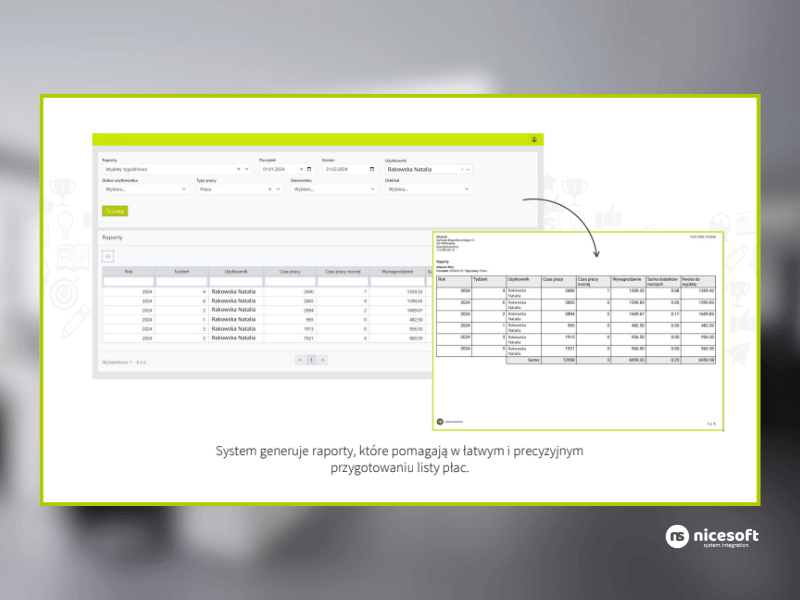
The system is extremely functional, as it will allow you to create and manage schedules, record overtime, redundancies or holidays, and, thanks to its integration with the payroll module, determine employee remuneration. In addition, it will enable you to register the entries and exits of employees to/from your company, which makes it easier to control their working time.
 Polish
  English