
Secure storage of personal data and confidentiality of correspondence in the light of legislation
The need to implement a data protection system in law firms is a topic that has been discussed for years. Ensuring and managing adequate safeguards is important not only for the protection of clients' interests, but above all for the law firm's credibility under the law.
Every law firm, including single-person law firms, according to the provision contained in Article 7(4) of the Personal Data Protection Act of 29 August 1997 (consolidated text of the Journal of Laws of 2015, item 2135), is a data controller. This means that should comply with regulations on the protection of personal data as well as classified documents. The obligations in this area are clarified by Regulation (EU) 2016/679 of the European Parliament and of the Council of 27.04.2016 on the protection of natural persons with regard to the processing of personal data and on the free movement of such data and repealing Directive 95/46/EC (General Data Protection Regulation, so-called RODO), which has been in force since 25.05.2018. What risks do law firms face and what safeguards do they need to take care of?
Security guidelines - what do every notary, solicitor and barrister need to know?
The daily work of a law firm is based on the continuous processing of information and hundreds of pages of documents. These include ordinary personal data as well as sensitive data, i.e. sensitive data, known as sensitive data, which relates, for example, to political views, religious affiliation, health status, but also information on convictions or sentencing decisions. Their leakage into the wrong hands would be catastrophic in its consequences, so their confidentiality is of the utmost importance.
Law firms must take care to set up an information security system in a comprehensive manner and consider the following aspects:
- Physical protection access to data, i.e. adequate security on the premises where they are stored;
- Organisational security and responsibility incumbent on all persons employed by the law firm, but also the realisation of the rights of those to whom such personal data relate;
- Regulations and regulations, regarding the processing of personal data, clauses, contracts;
- Technological safetyequipment and systems, on which the data is stored, including supervision of the data, confidentiality of correspondence and archiving and copies of the documents concerned.
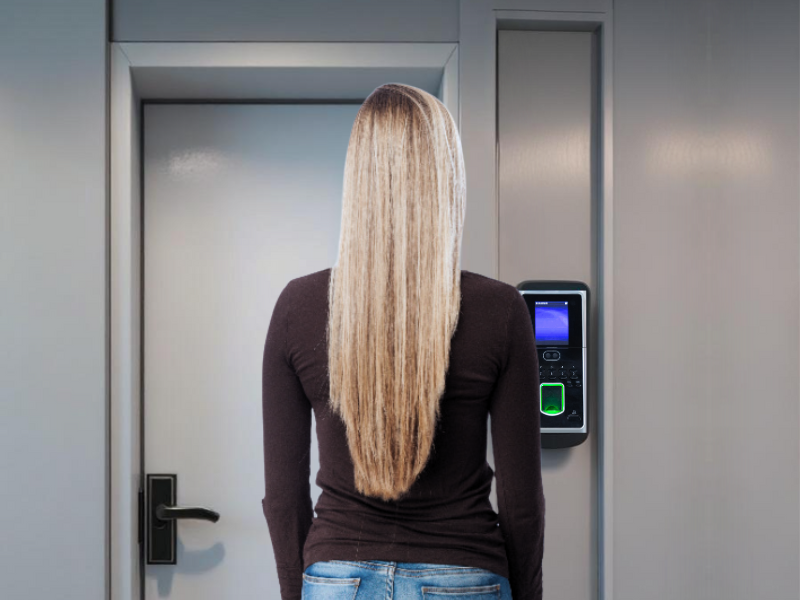
Security in a law firm - biometric terminal and facial geometry
The physical security of the premises where the law firm is located relates to appropriate equipment, consisting of certified cabinets for the storage of confidential documents and personal data, certified doors, locks, grilles or roller shutters. Additional preventive measures should include an alarm system and monitoring along with access control to the premises.
Investing in modern solutions increases the level of security against unauthorised entry attempts or forcible forced entry. For this purpose, biometrics can be used and terminals with face recognition technology, which recognise individuals with almost 100% accuracy, eliminating the risk of false identifications. Reliability and rapid verification, as well as seamless integration with existing access control systems, make it the perfect solution for law firm premises security.

Security of customer data and protection of ICT systems
Issues related to access to computer equipment, files and correspondence relate to safeguards against attempted hacking attacks or accidental leakage of sensitive data. Hence the need for data encryption, the use of advanced cloud solutions, regular backups and the use of strong passwords for access with multi-step authentication.
Cyber security should be taken care of with a comprehensive solution, using a system of UTM, which integrates several important security functions - monitoring, analysing and protecting network traffic in real time. What is UTM and why is it the perfect solution for law firms?

Protecting e-mail, network access and preventing hacking attacks
UTM stands for Unified Threat Management and is a system that allows you to secure your network on multiple levels. Its functionality is to provide multiple cybersecurity tools within a single solution. UTM is designed to protect computer networks against a broad spectrum of threats such as viruses, malware, DDoS attacks, phishing and unauthorised access.
There are two types of UTM, namely hardware (a physical device installed on the network) and software (software running on servers or computers). For law firms, it is the latter type that will be easy to deploy, as software UTMs are installed on existing infrastructure. How does this increase safety?
UTM scans network traffic and files, detects and eliminates viruses, trojans, worms and other forms of malware, and monitors the network for suspicious activity and blocks potential threats, before they can cause damage. It also filters unwanted emails and blocks phishing attempts, and enables secure, encrypted VPN connections, ensuring the confidentiality and integrity of transmitted data.

Backup of assets, data encryption and use of the cloud - aspects of cyber security in law firms
When it comes to protecting data and information stored on various media, regular backups should not be forgotten. Every law firm should ensure that backup not only for formal reasons, but above all for practical reasons. The cyclical creation of a copy of the data, which can be used to restore the original information in the event of hardware failure, malware attacks, file deletion or other unforeseen situations, provides peace of mind for all law firm staff.
In line with the saying „don't ask if a failure will happen, just when it will happen”, implementing a reliable backup system is important to ensure business continuity and avoid serious reputational and trust issues. Backup is performed according to a set schedule and adherence to the so-called 3-2-1 rule: storage of three copies of data on two different media, with one copy stored off-site.
The choice of data backup method can be consulted with IT systems specialists from the Nicesoft, They will suggest the optimum solution on the basis of the audit. Along with backups, it is also worth taking care to archive data that is not currently in use, but may be needed in the future.
The level of digital threats is constantly increasing and affects every industry equally. Law firms are businesses of increased trust, and it is trust and reputation, earned over the years, that is one of the most important issues for lawyers. Delegating the task of properly securing data to specialists not only minimises the risk of information leakage, but also allows you to benefit from the many conveniences in your daily work that modern technology provides.
 Polish
  English